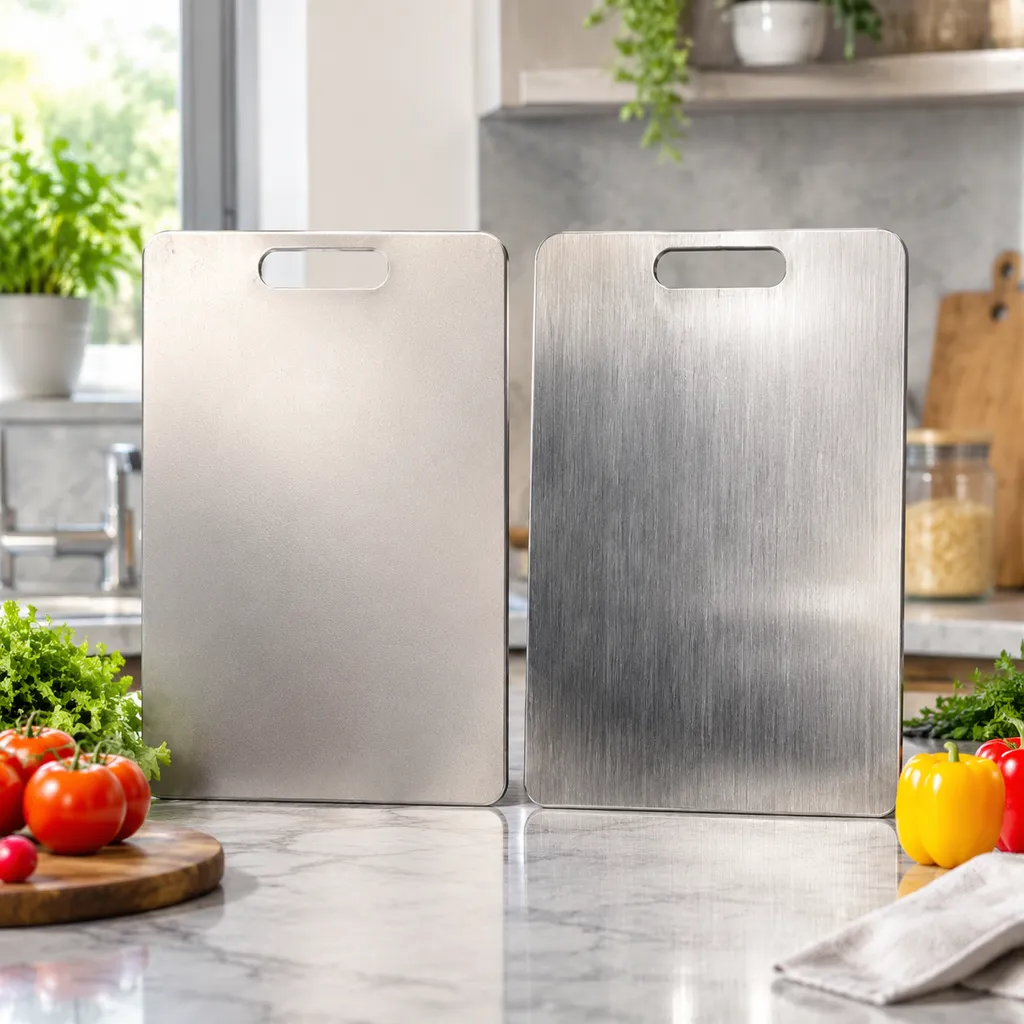
For a titanium vs stainless steel cutting board choice, both metals deliver a non-porous cutting surface that is easy to sanitize and free of wood odor retention or plastic wear debris. Titanium usually wins on lightweight handling and corrosion resistance; stainless steel wins on countertop stability, budget, and rigid dough or butcher work - while both accelerate knife edge wear versus wood or polymer. The sections below compare hygiene, blade dulling, durability, cutting board noise, and buying checkpoints for home and commercial kitchens.
Titanium vs Stainless Steel Cutting Board
Titanium vs stainless steel cutting boards both offer non-porous hygiene; SUS 304 stainless is the scalable commercial OEM standard CasaRasoi manufactures, while titanium remains uncommon and expensive for bulk kitchenware programs.
Choosing between a titanium vs stainless steel cutting board comes down to balancing hygiene, weight, and blade care in modern kitchen prep. Both options replace traditional wood and plastic surfaces with non-porous, easy-to-sanitize metal construction built for long-term daily use.
What Is a Titanium Cutting Board?
A titanium cutting board is crafted from solid, food-grade titanium or a titanium-alloy surface engineered for lightweight strength and superior hygiene.
- Lightweight Handling: Significantly lighter than steel, making it effortless to lift, carry to the stove, and wash in the sink.
- Pure Non-Porous Surface: Resists moisture, odors, and food stains without trapping bacteria in deep grooves.
- Gentle Metal Feel: Offers a slightly softer surface hardness than standard steel, helping reduce harsh impact on kitchen knife edges.
What Is a Stainless Steel Cutting Board?
A stainless steel cutting board is a heavy-duty prep surface typically manufactured from food-grade 304 or 316 stainless steel.
- High Structural Rigidity: Delivers a dense, unyielding work surface ideal for heavy chopping, dough rolling, and meat prep.
- Proven Corrosion Resistance: Stands up to acidic ingredients, water, and frequent high-heat dishwashing without rusting.
- Commercial-Grade Durability: Built to handle intense daily wear without warping, cracking, or absorbing food residue.
Key Differences at a Glance
| Feature | Titanium Cutting Board | Stainless Steel Cutting Board |
|---|---|---|
| Weight | Lightweight and easy to maneuver | Heavy and dense on the countertop |
| Surface Hardness | Moderately hard; slightly kinder to blades | Very hard; causes faster knife edge wear |
| Corrosion Resistance | Exceptional resistance to acids and moisture | High resistance (especially 304/316 grades) |
| Hygiene & Cleaning | Non-porous, odor-free, dishwasher safe | Non-porous, easy to sanitize, dishwasher safe |
| Noise Level | Noticeable metallic tap during chopping | Louder metallic clatter under heavy cutting |
| Price Point | Higher upfront investment | More budget-friendly and widely accessible |
Titanium vs Stainless Steel Cutting Board Hygiene and Safety
Titanium vs stainless steel cutting boards both offer non-porous hygiene; SUS 304 stainless is the scalable commercial OEM standard CasaRasoi manufactures, while titanium remains uncommon and expensive for bulk kitchenware programs.
When comparing a titanium vs stainless steel cutting board, food safety is the biggest reason home cooks and commercial kitchens make the switch from traditional materials. Both options give you a clean, non-toxic kitchenware solution that keeps your prep station safe without extra maintenance.
Antibacterial and Non-Porous Properties
Unlike wood or bamboo, neither titanium nor stainless steel absorbs liquids. A non-porous cutting surface leaves nowhere for raw meat juices, moisture, or bacteria to hide.[1]
- Zero Liquid Absorption: Juices stay on the surface rather than seeping into deep knife grooves.
- Easy to Sanitize: You can wash both boards with hot soapy water or sanitize them quickly between prep tasks without worrying about trapped food particles.
- High Moisture Resistance: Neither board swells, warps, or develops mold in humid kitchen environments.
Eliminating Microplastics and Chemical Leaching
Plastic boards shed tiny shavings every time your blade strikes the surface, which can end up directly in your food. Wood boards can also introduce glues, mineral oils, or chemical finishes into your meal prep.
Choosing a metal board - such as a custom stainless steel cutting board or a pure titanium alternative - completely removes microplastics from your prep routine. Both metals are food-grade and chemically inert, meaning they do not react with acidic ingredients like tomatoes, lemons, or vinegar.
Odor and Stain Resistance
Strong-smelling ingredients like garlic, onions, and raw fish often leave lingering scents on porous surfaces. Similarly, turmeric, beets, and berries can permanently stain plastic or light wood.
| Hygiene Factor | Titanium Cutting Board | Stainless Steel Cutting Board |
|---|---|---|
| Porosity | Non-porous | Non-porous |
| Microplastic Risk | None | None |
| Stain Resistance | Resists food pigments completely | Resists food pigments completely |
| Odor Retention | Does not trap garlic, onion, or fish smells | Neutralizes odors quickly with a simple rinse |
Because both metals create a hygienic cutting board surface, a quick wash leaves them completely odor-free and spotless for your next ingredient.
Titanium vs Stainless Steel Cutting Board Knife Edge Wear
Titanium vs stainless steel cutting boards both offer non-porous hygiene; SUS 304 stainless is the scalable commercial OEM standard CasaRasoi manufactures, while titanium remains uncommon and expensive for bulk kitchenware programs.
When comparing a titanium vs stainless steel cutting board, how the surface treats your kitchen knives is one of the biggest factors to consider. Both metals are harder than wood or plastic, which means your cutting technique and blade care matter more than ever.
How Titanium Affects Knife Blades
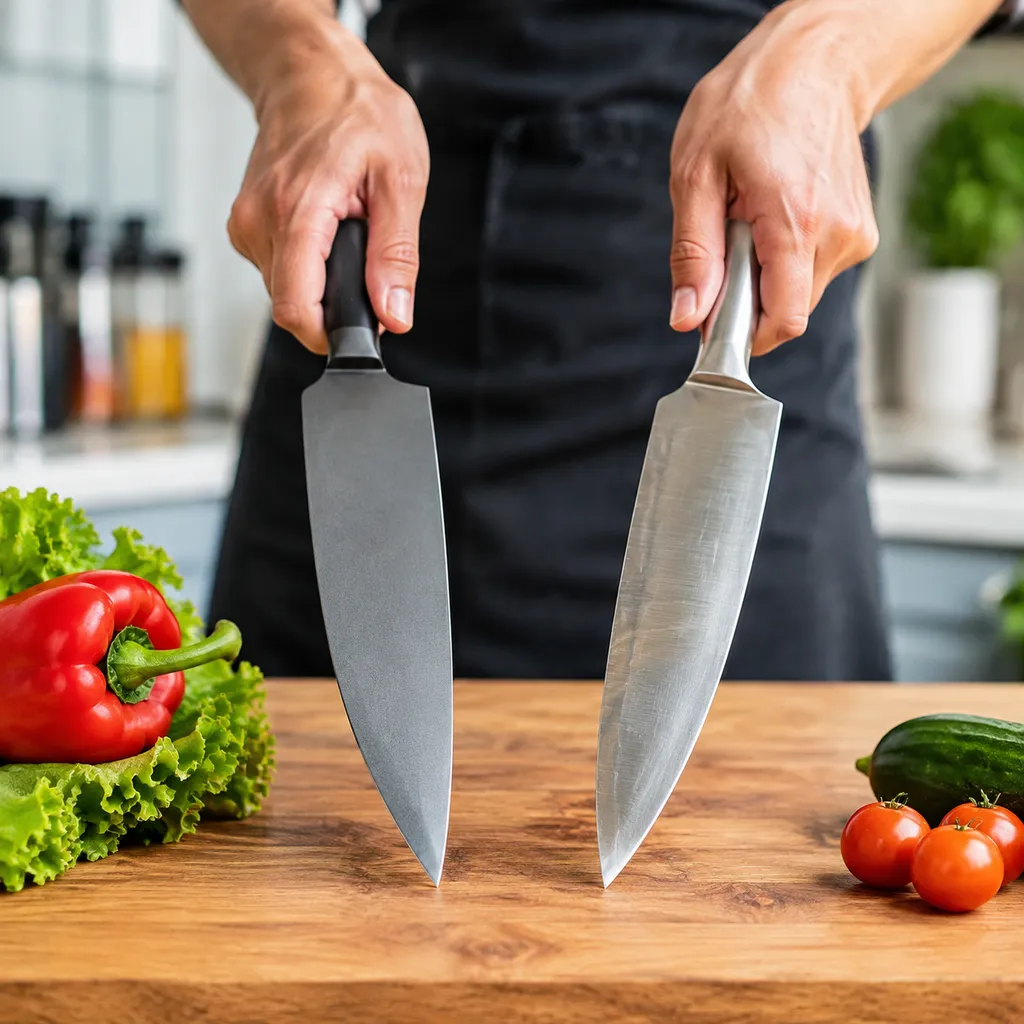
Titanium is noticeably softer than hardened kitchen knife steel. Because of this difference, pure titanium boards absorb some of the downward impact when your blade makes contact.
- Lower blade dulling: Titanium offers slight give compared to rigid steel, helping preserve edge sharpness during routine slicing.
- Visible surface marks: Because the metal yields slightly to sharp steel, you will see light scratch marks form on the board over time rather than severe rolling on your knife edge.
- Balanced feedback: Many home cooks find that titanium feels slightly less harsh on the wrists and blades during repetitive chopping.
How Stainless Steel Affects Knife Blades
Stainless steel is a rigid, dense alloy with a hardness level much closer to your actual knife blades. While a quality 304 stainless steel cutting board offers high durability and easy sanitization, that same rigidity means the surface does not cushion your blade upon impact.
- Faster knife edge wear: Repeated heavy chopping on stainless steel causes the microscopic edge of a knife to roll or flatten faster than it would on softer materials.
- Minimal board scratching: The surface resists deep grooves, keeping the metal smooth, though your knives take on more of the physical contact.
- Best for controlled cuts: Stainless steel performs best with smooth slicing motions, pastry work, and meat prep rather than aggressive cleaver chopping.
Best Practices for Protecting Your Knives
You do not have to give up the hygiene of a non-porous cutting surface to keep your blades sharp. Following a few simple habits will dramatically reduce blade dulling on any metal board:
- Use a slicing motion: Draw the knife smoothly across the food instead of slamming the blade straight down onto the metal.
- Hone your blades regularly: Run your chef's knife along a honing steel every few uses to realign the edge before it feels dull.
- Avoid delicate Japanese knives: Save ultra-thin, high-carbon blades for softer boards, and use standard Western stainless steel knives for daily metal board prep.
- Keep a dedicated heavy-duty board: If you regularly hack through thick bones or frozen foods, pair your metal prep station with a thicker board designed for heavy impact.
Titanium vs Stainless Steel Cutting Board Durability and Longevity
Titanium vs stainless steel cutting boards both offer non-porous hygiene; SUS 304 stainless is the scalable commercial OEM standard CasaRasoi manufactures, while titanium remains uncommon and expensive for bulk kitchenware programs.
When comparing a titanium vs stainless steel cutting board, long-term performance comes down to how each metal handles daily kitchen abuse. Because neither surface absorbs liquids or harbors trapped food particles, both offer serious advantages over traditional materials in terms of metal cutting board durability and hygiene.
Scratch Resistance and Daily Wear
Neither metal is completely immune to cosmetic marks, as steel knife blades will leave fine surface scratches over time. However, how those scratches behave makes a clear difference in daily use:
- Titanium Boards: Titanium is softer than high-carbon knife steel, meaning it develops light surface scratches faster. Because those marks stay shallow, they do not trap moisture or bacteria, and they actually help cushion your blade edge during heavy chopping.
- Stainless Steel Boards: Food-grade stainless steel is harder and resists deep gouges better during heavy cleaver work. Over months of use, it builds up a uniform brushed patina rather than deep grooves.
- Structural Integrity: Both metals completely eliminate warping, cracking, and splitting - common failures seen in wood and bamboo boards.
Dishwasher Safety and Cleaning Ease
Routine cleanup is where both options shine as a non-porous cutting surface. You never need to oil, condition, or sand either board.
- Dishwasher Safe: Both titanium and stainless steel handle high-heat dishwasher cycles without bending, melting, or degrading.
- Quick Hand Washing: A simple rinse with warm water and standard dish soap removes grease, raw meat juices, and strong odors in seconds.
- Moisture and Rust Resistance: Both materials deliver superior moisture resistance and corrosion resistance. Quality stainless steel resists rust well, while titanium is virtually impervious to oxidation - even when exposed to acidic foods like tomatoes and citrus every day.[2][3]

Long-Term Lifespan and Value
Choosing between a rust-resistant cutting board made of titanium or stainless steel depends on your upfront budget versus weight preferences:
| Feature | Titanium Cutting Board | Stainless Steel Cutting Board |
|---|---|---|
| Expected Lifespan | Decades of daily use | Decades of daily use |
| Upfront Cost | Higher initial investment | More budget-friendly |
| Weight & Handling | Lightweight metal cutting board; easy to lift and store | Noticeably heavier; stays planted on the counter |
| Maintenance Needs | Zero conditioning required | Zero conditioning required |
As a cutting board manufacturer and OEM/ODM kitchenware supplier, we build both options to last for years without needing replacement. If you are sourcing durable kitchenware for retail or commercial kitchens, explore our full product catalog to compare board thicknesses, finishes, and sizing specifications.
Practical Kitchen Use and Cooking Scenarios
Titanium vs stainless steel cutting boards both offer non-porous hygiene; SUS 304 stainless is the scalable commercial OEM standard CasaRasoi manufactures, while titanium remains uncommon and expensive for bulk kitchenware programs.
Choosing between a titanium vs stainless steel cutting board often comes down to how you cook every day. Both bring a hygienic cutting board surface to your prep station, yet they handle daily tasks quite differently.
Best Uses for Titanium Cutting Boards
Because a lightweight metal cutting board is easy to pick up, carry, and rinse between tasks, I reach for titanium during fast-paced daily prep. Its moisture resistance and corrosion resistance make it reliable across wet and dry ingredients alike.[4]
- Everyday Meal Prep: Ideal for slicing vegetables, fruits, and boneless meats without straining your wrists.
- Outdoor and Portable Cooking: A compact titanium board packs easily into gear bags, similar to dedicated custom camping cutting boards built for travel and outdoor kitchens.
- Quick Ingredient Transfers: You can lift the board with one hand and scrape chopped herbs or diced onions straight into a hot pan.
Best Uses for Stainless Steel Cutting Boards
Stainless steel tends to feel heavier and stiffer on the counter, which makes it shine during heavy-duty kitchen work.
- Baking and Pastry Rolling: The cool, flat, non-porous cutting surface stops dough from sticking when rolling pie crusts or kneading bread.
- Butchery and Heavy Prep: Extra weight keeps the board planted when portioning large roasts, breaking down poultry, or prepping messy seafood.
- High-Heat Staging: You can safely set hot cookware on top without warping or scorching the surface.
Noise Levels, Grip, and Stability on Countertops
Cutting board noise and movement are two common concerns when switching from wood or plastic to metal.
| Kitchen Factor | Titanium Cutting Board | Stainless Steel Cutting Board |
|---|---|---|
| Cutting Sound | Produces a sharper metallic tap when chopping fast | Feels slightly more muted due to thicker, heavier gauge metal |
| Countertop Grip | Can slide easily on smooth stone unless paired with silicone feet | Heavier weight helps anchor it, though a damp towel underneath still helps |
| Handling & Storage | Effortless to move, wash, and slide into narrow racks | Takes two hands for larger sizes and needs sturdy storage |
If your kitchen setup demands specific dimensions, edge profiles, or non-slip backing, exploring custom cutting boards lets you match the exact size and stability features to your countertop workflow - including custom non-slip cutting boards when grip is the priority.
Buying Guide: Which Metal Cutting Board Should You Choose?
Titanium vs stainless steel cutting boards both offer non-porous hygiene; SUS 304 stainless is the scalable commercial OEM standard CasaRasoi manufactures, while titanium remains uncommon and expensive for bulk kitchenware programs.
Picking between a titanium vs stainless steel cutting board comes down to your daily cooking habits, budget, and kitchen setup. Both give you a hygienic, non-porous cutting surface, yet each fits a different workflow.
When to Choose a Titanium Cutting Board
Go with titanium if you want a lightweight metal cutting board that feels effortless to move from the prep counter to the sink or stove.
- Fast daily prep: Easier on your wrists when lifting, rinsing, and scraping chopped ingredients into a pan.
- Outdoor and compact kitchens: Ideal for camping, RVs, or small apartments where storage space and weight matter.
- Extra corrosion resistance: Holds up reliably when prepping acidic foods like tomatoes, lemons, and vinegar marinades without reacting.
- Gentle feel under the blade: Slightly softer on the surface than hardened steel, helping reduce noticeable knife edge wear during quick slicing.
When to Choose a Stainless Steel Cutting Board
Choose stainless steel if you want maximum weight, countertop stability, and budget-friendly metal cutting board durability for heavy-duty tasks.
- Dough and pastry work: Keeps a cool surface temperature that prevents butter from melting while rolling pie crusts or kneading bread.
- Heavy chopping and meat prep: Offers strong impact resistance and stays planted during vigorous butcher-style tasks.
- Value-focused buying: Delivers a rust-resistant cutting board at a lower price point, making it practical for stocking multiple sizes or sourcing wholesale cutting boards for commercial kitchens.

Key Features to Look for Before Buying
Before you buy, check the build details that separate a reliable board from one that slides around or warps over time.
| Feature | What to Check | Why It Matters |
|---|---|---|
| Material Grade | Pure titanium or food-grade 304 / 316 stainless steel | Ensures safe food contact, moisture resistance, and long-term durability. |
| Board Thickness | About 1.5 mm to 2 mm for most countertop sizes | Helps limit bending, flexing, or loud hollow ringing when chopping. |
| Countertop Grip | Silicone corner pads, a non-slip mat, or a lipped edge | Keeps the smooth metal surface from sliding on granite, quartz, or wood counters. |
| Edge Finishing | Smooth, rounded, or beveled corners | Protects your hands during handling and makes washing safer. |
| Surface Finish | Brushed or matte texture | Hides fine surface scratches better than a mirror-polished finish. |
If you also keep secondary boards on hand for specialized prep or delicate Japanese knives, pairing your metal board with easy-to-clean custom plastic cutting boards - or reviewing our wood vs plastic cutting board guide - gives your kitchen a versatile setup for every ingredient.
Frequently Asked Questions
Titanium vs stainless steel cutting boards both offer non-porous hygiene; SUS 304 stainless is the scalable commercial OEM standard CasaRasoi manufactures, while titanium remains uncommon and expensive for bulk kitchenware programs.
Do Metal Cutting Boards Dull Knives Quickly?
Yes, hard metal surfaces cause faster knife edge wear than softer materials. When evaluating a titanium vs stainless steel cutting board, remember that both metals are harder than wood or traditional polymer boards. While pure titanium is generally slightly softer than hardened stainless steel - offering a tiny bit more forgiveness - both will accelerate blade dulling if you chop heavily.
To protect your blades while enjoying a hygienic cutting board:
Use a light touch: Avoid heavy, downward cleaver strikes.
Hone regularly: Keep a honing steel nearby to realign the blade edge after prep.
Rotate boards: Keep a softer alternative, such as a commercial-grade HDPE plastic cutting board, on hand for heavy-duty butcher work and delicate high-carbon Japanese knives.
Is Titanium Better Than 304 or 316 Stainless Steel?
Titanium is better if you prioritize weight and extreme corrosion resistance, while 304 and 316 stainless steel excel in budget-friendly rigidity.
- Weight and Handling: Titanium delivers a lightweight metal cutting board experience that is much easier to lift, wash, and store than dense steel slabs.
- Durability: Both 316 marine-grade stainless steel and titanium offer superior moisture resistance and hold up against acidic foods without rusting. However, titanium handles daily impacts without denting as easily as thinner gauge 304 steel.
- Value: As a cutting board manufacturer, we see stainless steel favored for heavy commercial prep tables due to cost, whereas home cooks often prefer titanium for easy daily handling.
Are Metal Cutting Boards Safe for All Types of Food Prep?
Metal boards are completely food-safe and give you a non-porous cutting surface that will not trap raw meat juices, odors, or bacteria. Because they are non-toxic kitchenware options, you do not have to worry about microplastics flaking into your meals or chemical leaching.
They are easy to sanitize in a standard dishwasher, making them ideal for raw poultry, seafood, garlic, and colorful vegetables. Just keep two practical habits in mind:
Prevent slipping: Always place a damp towel or silicone mat underneath so the board stays locked on your countertop.
Mind the noise: Expect sharper clattering sounds when chopping hard root vegetables compared to quieter wood or polymer boards. For insight into how different kitchenware materials are tested and produced, explore our kitchenware manufacturing quality standards.
References
Titanium vs stainless steel cutting boards both offer non-porous hygiene; SUS 304 stainless is the scalable commercial OEM standard CasaRasoi manufactures, while titanium remains uncommon and expensive for bulk kitchenware programs.
- USDA FSIS - Cutting Boards (nonporous surfaces and cleaning) ↩
- AZoM - Titanium Alloys: Corrosion and Erosion Resistance ↩
- AZoM - Stainless Steel Grade 316 (UNS S31600) ↩
- Engineering Toolbox - Metals and Alloys Densities ↩
- AZoM - Titanium Alloys: Physical Properties
- WHO - Food safety fact sheet